Tuesday, August 26, 2008

Hitmen on Holiday: In Bruges (2008)


Writer-Director Martin McDonagh’s pitch-perfect film debut opens with two hitmen arriving in the picturesque Belgian city of Bruges. The two are fresh off a botched job back in the U.K., and have been sent by their boss to hide out in the medieval city of cathedrals and canals to await his instructions. Veteran Ken (Brendan Gleeson) is immediately taken by the city, and jumps at the chance to play tourist, while hotheaded rookie Ray (Colin Farrell) declares Bruges a “shithole” on arrival and sees no point in doing anything other than drink in the pub. After all, he says, history is “all just a load of stuff that’s already happened.”

On its surface, In Bruges is a story we’ve seen many times before. Even the personal demons of the characters, like Ray’s grief over having accidentally killed a child on their last job or Ken’s calm detachment from his occupation are at this point old plot devices (the killer with emotional issues is one of the most ubiquitous tropes in recent cinema--see You Kill Me, The Matador, Analyze This, The Sopranos and the entire action movie catalog of Nicholas Cage). But McDonagh, best known as a playwright, is a gifted writer of dialogue, and manages to mine Ray and Ken’s mundane and often silly conversations for hidden and surprising depths. His devil-may-care attitude toward plotting is a bit less elegant-- to call the film overplotted is an understatement--but it’s also a big part of what ultimately makes In Bruges so funny and sets it apart from others like it. So after we’ve seen Ray punch a woman, snort coke with a dwarf and two Dutch hookers, and insult just about every social demographic to its face, we are able to let go of any preconceived notions and resign ourselves to going where McDonagh takes us.

Fortunately, the road he takes is more interesting than the genre usually allows, and In Bruges offers some really delightful surprises in its second half. Towering over all the rest is the introduction of Ralph Fiennes as Ken and Rays’s boss Harry, a foul-mouthed, foul-tempered Brit that is the most simultaneously likable and loathsome screen villain that I’ve encountered in some time. Fiennes seems to be channeling Ben Kingsley in Sexy Beast here, with his steely-eyed glare and stiff posture (not to mention the string of curses he lets fly ever time he opens his mouth), but he makes the character his own. While Kingsley’s Don Logan was a single-minded, unstoppable force of nature, Fiennes brings some oddly human tics to his performance, playing Harry as the kind of old-school hood that acts on “a point of honor.” He's a proper British thug, and even when he’s shooting a man or overflowing with anger, he’s quick to insist it’s nothing personal.

While Fiennes manages to steal a few scenes near the end of the film, including a shootout with Farrell that’s one of the funniest action scenes in recent memory, the majority of drama in the film is placed firmly on the shoulders of Farrell and Gleeson, and thankfully so. They make a great odd couple, eventually falling into a father-son dynamic that makes for some great humor at the same time that it's oddly touching (see the way Gleeson looks at Farrell and gives him advice before the other leaves for a date). Gleeson’s an old pro, and you expect him to be great (and he is), so it's Farrell's performance that comes as the big surprise here. He seems born to play the role of Ray, and he delivers his most petulant and inappropriate lines (“Look! They’re filming midgets!”) with a childish glee that is infectious and completely believable. Still, where Farrell and Gleeson really prove themselves is not in the film’s lighter moments, but when the mood gets serious. When the two discuss their belief in God or Ray’s anguish at having killed a little boy, it’s genuinely touching. McDonagh’s not just giving the audience half-hearted emotional filler to kill time between the one-liners, but genuine human drama, and this credibility only makes the jokes all the more funny when they do come.

Despite the stellar performances, not enough praise can be showered on McDonagh's script, which is the most tightly constructed of the year. His writing and the film as a whole have already earned him comparisons to Quentin Tarantino, but this parallel couldn’t be further off the mark. When Tarantino’s hitmen in Pulp Fiction indulge in inane chatter about TV pilots or what they call a Quarter Pounder in Amsterdam, it really is inane. McDonagh, on the other hand, imbues every aspect of In Bruges with meaning. Every line, every character, every action ultimately plays a part in the overarching narrative to an almost absurd degree. McDonagh has written the hell out of this movie, so to speak, and the fact that the characters and the drama are still so believable in such an overloaded script is only all the more to his credit.

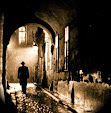
I’d be remiss here not to mention the fourth key character in the story-- the city of Bruges itself. Love it or hate, this film will still succeed in making you want to go visit this truly remarkable city, which prior to seeing the film I had only heard of in passing. McDonagh makes a joke out of Harry repeatedly referring to it as “a fairy tale place,” but it’s an apt description of the city’s cobblestone streets and canals, which have led to its being dubbed “the Venice of the North”. The fact that McDonagh decided to stage such a subversive, joyously offensive film in this city that seems so staid and proper is just yet another of the many strokes of brilliance on display here.

Sunday, August 24, 2008

"And There Was a Great Earthquake..."

One of my favorite long takes from Stalker (1979). Sort of makes up for the other three hours where he barely moves the camera.

Tuesday, August 12, 2008

Recently Seen...

There Will Be Blood (2007) D: Paul Thomas Anderson

After a year of hype, I finally got around to seeing this one. I’ve never been a big P.T. Anderson fan, but this movie did prove to me that he is a hell of a technical filmmaker. Nearly every shot is perfectly composed, and the score, by Johnny Greenwood of Radiohead, manages to hit just the right note of absurd menace. The only problem, then, is Anderson’s script. Just like every film he’s made so far, it starts out strong before taking a nosedive and becoming outright plodding in its second half. I can still remember seeing Boogie Nights and wondering what the hell had happened to Anderson’s story when it reached the scene at the drug dealer’s house more than two hours in. The same thing happens in There Will Be Blood when Kevin J. O’Connor shows up claiming to be Daniel Plainview’s brother. It immediately seems out of place, and after a truly useless thirty minutes it becomes clear that his character has only been inserted into the story to serve as an audience for Plainview’s “I hate most people” monologue. That’s just lazy writing, especially in a two-and-a-half hour long movie.

I will jump on the bandwagon and say that Daniel Day Lewis is superb here. I completely bought his character in every way, and he certainly deserved the Academy Award he got, if only because he manages to inject meaning and ironies into his performance that are completely absent in the writing. He certainly blows Paul Dano’s sniveling faith healer out of the water every time the two have a scene together, and for better or worse, he does feel like a great American character. But he’s always bumping up against the shortcomings of the story. Anderson seems to be trying to make a big statement here, but I don’t know what it is, and I’m not sure he does, either. We get an ambitious, greedy oil man, and a smarmy false prophet, but I don't see what one has to do with the other. The film's tagline is "When Ambition Meets Faith." But isn't the character of Eli Sunday just as ambitious as Daniel Plainview? And Plainview, in his capitalist sort of way, certainly has faith in himself and his ability to succeed. So what, then? Is this film a statement on the shortcomings of capitalism and religion? On the hollowness of worldly pleasures? Is it a parable about the sacrifices made in the name of progress? Or how a man can be consumed by his own ambition? Anderson shows us parts of all these themes in varying degrees. The problem is that There Will Be Blood doesn’t have anything new or interesting to say about any of them.


If... (1968) D: Lindsay Anderson

60s-era English school kids rebelling against the establishment can become an odd metaphor the violence of the present. That’s the way most Americans, with thoughts of school shootings all too fresh in their minds, are bound to read Lindsay Anderson’s classic Angry Young Man film. In reality, If... isn’t actually that fixated on violent young people (I’m not too sure the shootout that closes the story even really happens-- it might be yet another one of the fantasy sequences that populates the whole of the film.) It’s more about class structure, insurrection, and the way values are so often sacrificed in the act of revolution (to change society one has to be willing to employ its methods-- which here means violence). It’s impossible not to read the film in the context of the May ’68 student uprisings in Paris, but I think Anderson was concerned with a lot more here than being topical, and the film's target is nothing less than the whole of the English social structure.

The style of the film is a bit perplexing (I spent the better half of it trying to decipher the relevance of the seemingly random shifts from black and white to color, only to read afterward that Anderson had experienced trouble trying to light certain locations and had used the black and white merely out of utility), but Malcolm McDowell seems born to play the role of Mick Travis, and you can see here the blueprint that has been followed by a number of British actors over the years. I’ve little doubt that this is the film that convinced Stanley Kubrick that McDowell could play Alex in A Clockwork Orange. As for Anderson, he started out making documentaries, and you can see that style at work in the film’s first hour, which documents the dreary life of the school as though it had been filmed by Grierson or the Maysles Brothers. The film then takes a shift toward the surreal in its second half, and ends up feeling oddly like a Bunuel movie. This dissonance manages to be one of the its strong suits, and helps to set the scene for the truly bizarre final half hour that has to be seen to be believed. If... is certainly one of the stranger films I’ve seen in a long time. I felt oddly removed from it while watching it, even alienated, but afterward I had the distinct impression that I’d seen something great.


The Motorcycle Diaries (2004) D: Walter Salles

There’s not all that much plot in The Motorcycle Diaries. Two friends meet, take a motorcycle trip through South America, and then part ways. It would be unspectacular, if one of the two didn’t turn out to be Che Guevera, the famed revolutionary (and t-shirt image). The odd thing is that Salles and screenwriter Jose Rivera play out the story as though they have no knowledge of the history surrounding the main character. Indeed, nothing in Ernesto Guevera, played with astounding sympathy by Gael Garcia Bernal, suggests that this retiring, asthmatic young man would one day be the spokesman for an entire revolution, serving as the voice of a philosophy and leading armies of guerillas through the jungles of Bolivia. Outside of a few throwaway lines, the only uncommon aspect of his character is his extreme honesty-- a trait that the script annoyingly allows to be pointed out by nearly every character he encounters. But even this is excusable, because The Motorcycle Diaries works around the friendship of the two main characters and the amazing scenery they encounter as they ride (and often fall off of) a beat up motorcycle across the continent (this film has been described by others as one giant travel ad for South America-- and they’ve definitely got a point). I can confidently say that this is one of the most manipulative movies I’ve seen. The film haphazardly shoves images of downtrodden communists, oppressed Indians, and postcard-like shots of Macchu Picchu and the Argentine countryside down the viewers’ throats, just hoping to get an emotional reaction. The surprising thing, then, is that it so often succeeds. As a love letter to youthful exuberance, adventure, and friendship, The Motorcycle Diaries manages to be emotionally affecting at the same time that it’s intellectually and politically implausible. And sometimes, that’s perfectly alright. There’s not really any “there” there, but thanks to Salles’ languid pacing, a sweetly melodic soundtrack, and truly moving performances from Bernal and Rodrigo de la Serna as his best friend Alberto, The Motorcycle Diaries manages to achieve an almost perfect kind of sophism.

Tuesday, August 5, 2008

Missing the Mark: The Grand (2007)


Zak Penn’s sophomore effort The Grand has just about everything going for it. For one, it’s stuffed to the hilt with funny people: Woody Harrelson, Cheryl Hines, David Cross, Dennis Farina, Chris Parnell, Gabe Kaplan, Ray Romano, and Michael McKean are all a part of the cast. Even Werner Herzog makes a cameo. It’s also got the kind of promising plot (a group of eccentrics competing in a high-stakes Vegas poker tournament) that seems catered to the self-reflexive, Christopher Guest-style improvisational comedy that worked so well in Penn’s directorial debut, Incident at Loch Ness. With all this in mind, it only seems all the more disappointing that The Grand is devastatingly mediocre. It’s by no means a total misfire, but for every joke or scene that’s worthy of a laugh, there are two or three that fall flat. In the end, it never manages to be more than just offhandedly amusing.

What’s so odd about The Grand is that the parts of it that are actually funny are what end up being its undoing. Penn and Matt Bierman, who wrote the 29-page script that the improv scenes work around, built up a massive backstory around each of the main characters, and these parts of the film prove to be its funniest moments. We learn about Harrelson’s character “One Eyed” Jack Faro, a lifelong substance abuser(“If you can drink it, snort it , shoot it or smoke it, then I’ve done it”), who’s been married more than fifty times and is trying to win the titular poker tournament to save his family’s casino. There is also Chris Parnell as a socially awkward poker genius who quotes lines from Dune at the table, and Hines and Cross as Lainey and Larry Schwartzman, twin siblings that have been forced into competition since birth by their overbearing father (Gabe Kaplan). All of these backstories, including Farina’s as an old-school Sinatra type and Richard Kind as a dimwitted amateur, are quite admirably constructed, and make for some of the movie’s most laugh-out-loud moments. Penn uses graphics and cut scenes to slip in some sly humor, and one bit where Herzog’s character (a leather-clad sociopath known only as “The German”) is photoshopped into old photos is too ridiculous not to be hilarious.

The problem, then, is that once Penn has exhausted the fun of introducing this motley crew of characters, we wish we could watch them do something more interesting than play cards. If the lack of movies centered around poker (especially when it’s so wildly popular) tells you anything, it’s that it’s not the most compelling thing in the world to watch, and The Grand is about as much proof of that as you need. After introducing everyone and giving them the opportunity to execute some more high concept jokes, what we’re left with is essentially the movie version of that Celebrity Poker Showdown TV show (which, oddly enough, no less than three of these actors have appeared on).

The structural problems introduced by the lengthy backstories take their toll on the actors, as well. Given such fully formed characters early on, most of the stars involved have nowhere to go, and the majority of them fall into the trap of latching on to one or two quirks of their character and trying to milk them for all they’re worth. Cheryl Hines, usually great on HBO’s improvised series Curb Your Enthusiasm, plays the lone female ringer, a mother of four with an oddball husband (Ray Romano, surprisingly funny) that was once struck by lightning. Although she’s onscreen perhaps more than anybody else, she’s given the least to do, and eventually resorts to just saying “fuck” every other word in attempt to get cheap laughs. But while Hines still in no way discredits herself, some of the other actors do, most notably improv vet Michael McKean as Steve Lavisch, a seemingly retarded real estate tycoon that’s gunning for Harrelson’s casino. Penn must’ve figured that he could let a guy who’d appeared in This Is Spinal Tap run wild with little direction, but the result is one of the most dreadfully unfunny performances in the film. Similarly, Gabe Kaplan seems to singlehandedly drag the life out of most of the scenes he’s in, and David Cross is also uncharacteristically weak, though he too seems to have little to work with.

Not surprisingly, the best performances in The Grand come from the characters that were given the best backstories, where the one-note joke of their character doesn’t get old too fast. Harrelson is probably the best as the whacked-out born loser Jack Faro, who wears hippie beads and Willie Nelson t-shirts at the poker table and designs novelty casinos like “The Chicago Fire,” where part of the building was always in flames (“it burned down”). Meanwhile, Chris Parnell also works as Harold Melvin, the math genius that lives with his mom and slurps vitamin shakes all day to keep himself mentally sharp. Usually when an SNL-alum is thrown into a comedy film they prove to be one of the weak links, but Parnell is consistently funny here, repeatedly getting laughs out of speaking in a low, nerdy monotone. Michael Karnow, formerly a voice actor for a number of Nickelodeon shows, also steals a lot of laughs as Mike Wierbe, a TV announcer that never misses a chance to plug his book and DVDs for “The Wierbe Method” of poker. Karnow seems to get the zany mood this film requires just right, and his interaction with his straight man co-host Phil Gordon (an actual poker pro) makes for some nice moments.

Penn’s Incident at Loch Ness was for me a minor stroke of genius, playing on the dual legends of the Loch Ness monster and Werner Herzog in a way that was intelligent, fresh and often outright hilarious. The Grand is working on a much smaller conceit, but it still manages to miss the mark because of its overall lack of structure. I’ve yet to mention that in addition to the ad-libbed dialogue, the actors in the film actually played the final table of the poker tournament and let the story be decided by who won. It’s seems like a cool idea, and even I was taken by it at first, but in hindsight it’s a big part of why the movie fails to live up to its potential. Sure, it’s faithful to the improvisational technique the filmmakers are working with, but it also runs counter to setting up a truly well-structured, funny story. When improv is done right, you can get classics like Spinal Tap and the best of Christopher Guest, but when it’s bad, it can be really painful to watch, territory that The Grand flirts with just a little too often.

Monday, July 28, 2008

Viewings 7/20/08-7/27/08

It seems I just don’t have (or find) enough time to write long form reviews of most of the films I see. That’s why I’m going to start posting these groupings of short reviews every week to fill in the gaps...

Belle De Jour
(1967) D: Luis Bunuel

Catherine Deneuve stars as Severine, a bored French housewife who makes up for her sexless marriage by indulging in erotic fantasies. Since it’s a Luis Bunuel film, these daydreams are a whole lot weirder than they are sexy-- one in particular involves her being tied to a barn while two men throw mud on her and call her dirty names. When she hears of a secret brothel, Severine goes to see the madam, and is soon working as a prostitute by day while maintaining her genteel-- and celibate-- bourgeois life at night. Like most Bunuel movies, Belle De Jour includes a healthy dose of the surreal, as well as satire of the soulless middle class and a few witty jabs at organized religion. Oddly enough, and despite the subject matter, the result is a movie that is probably the most conventional film he made in France-- the story has a definite three acts, and even the frequent dream sequences are more clearly delineated as such through some interesting sound design (we hear the sound of bells-- originally linked to a horse carriage in the film’s first scene--every time Severine begins to fantasize). But Bunuel is still a master of the subversive, and like his masterpiece Viridiana, Belle De Jour is notable for suggesting the deepest of perversions without ever resorting to showing them. Consider a scene where a Chinese businessman comes to the brothel. He carries a box that makes a buzzing sound every time he opens it, and though the camera never shows what it contains, the disgusted reactions of the prostitutes are enough to conjure up all manner of depravity. But the joke is on us: Bunuel noted in his book My Last Sigh that he never knew what was in the box. What he did know was that his audience, no matter how dignified they considered themselves, could be counted on to fill in the gaps.


Shotgun Stories (2007) D: Jeff Nichols

Here’s a fine movie that was more or less ignored by the mainstream critics. Three brothers known only as Son, Kid, and Boy, find out that their hateful father has died after leaving them behind, finding God, and starting another family. The three crash the funeral, and have soon started an all out feud with their half-brothers that quickly escalates from bitterness to bloodshed. In many ways, Shotgun Stories is the most American movie I’ve seen this year. Unlike most mainstream fare with its streamlined (and often manufactured) cultural identity, this is a film that could have been made no where else except the Southern U.S., specifically Arkansas. It feels real and honest because it is steeped in the culture that it sprang from. Director Jeff Nichols took the characters that are placed in the periphery and played for laughs in most films and made them the center of his movie, and the result is one of the most humane films to come along in a while. The mostly non-professional cast is nearly universally excellent, especially Douglas Ligon as the gentle but ineffectual Boy, who would rather live in a van in “early retirement” than get a job. Michael Shannon (most notably of the underrated Bug), the only name actor in the cast, once again distinguishes himself as one of the most unique performers working today. He certainly has one of the most interesting faces of any young actor around. Forget Gus Van Sant and all the people saying he’s achieved something resembling De Sica and the Italian Neorealists. This is a movie that feels like it’s about real people.


Stone Reader (2002) D: Mark Moskowitz

This documentary follows filmmaker Mark Moskowitz as he tries to track down the writer of what he considers a forgotten classic of literature. The book, The Stones of Summer, and its writer, Dow Mossman, were briefly hailed as visionary in 1972 before fading into oblivion. By the time Moskowitz discovers the book in 2001 it has become so obscure that even the jacket designer doesn’t remember it. While it’s ostensibly about the search to find Mossman and ask him why there was never another book, Stone Reader is more about the beauty of reading and the gifts that good literature can continue to give to its readers (one writer charmingly calls it “the only pleasure that never gets old”). If that sounds like the kind of maudlin preaching you remember form your elementary school librarian, rest easy. Moskowitz is on the whole able to steer clear of the mountain of cliches that surround his subject. Where the problems lie are not in his content but in his technical skill as a documentarian and editor. He attempts a self-reflexive approach wherein we see the making of the documentary as we watch it, and while this does allow for some nice touches, in particular one scene where Moskowitz handles the unprinted film of the scene the audience has just witnessed, it ultimately makes the film overlong and unnecessarily convoluted. That’s not even mentioning the completely lifeless color palette that Moskowitz insists on using. For a guy who’s trying to make reading look interesting to people, he does him self a disservice by making his movie look as though it were a relic of the mid-eighties.

Thursday, July 24, 2008

Zero For Conduct

This is film critic and writer Michael Atkinson's personal website, and it's well worth checking out. He currently has a link up to an essay he wrote that's one of the best things I've read on Werner Herzog. The name of the blog, interestingly enough, comes from the 1933 Jean Vigo film Zero de Conduite, also worth checking out. Definitely one of my all time favorite movie titles.

Monday, July 14, 2008

Sinister Seduction: The Beguiled (1971)


The Beguiled finds Clint Eastwood playing against the type of character that had made him a star in films like A Fistful of Dollars and The Good, The Bad and The Ugly. While the stoic Man With No Name let his actions do the talking, John “Mc B” McBurney, the injured Union soldier at the center of Don Siegel and Eastwood’s forgotten pre-Dirty Harry collaboration, is a man who uses his silver tongue to allure, win over, and ultimately deceive his marks. In short, he’s not a very nice guy-- but then few characters in The Beguiled are. The film, which Siegel noted as a personal favorite in his long career, is an exploration of repressed sexuality and human treachery, and its unhinged characters-- who range from the misguided and spurned to the downright malicious-- are what make it an interesting and subtle twist on the typical Western formula.

The film is set at an isolated school for girls during the Civil War. Battles rage just outside of the plantation gates, and the school’s headmistress Martha Farnsworth (Geraldine Page) is often forced to turn away sex-starved soldiers who show up looking to “protect” her students, but otherwise the school exists as a peaceful oasis in the middle of the devastated South. That is until John McBurney, a wounded Union soldier, arrives looking for help, and the young girls, along with head teacher Edwina Dabney and the lone slave woman Hallie, reluctantly take him in and care for him. McB’s status at the school is uncertain-- he is, after all, the enemy-- and upon awakening he isn’t sure if he is a patient or a prisoner, though the wooden boards that Ms. Martha nails over his windows are not too heartening. A ladies' man who's as smooth as he is creepy (“old enough for kisses,” he says to one girl upon learning she is twelve), McBurney takes to flirting with the girls to pass the time and get on their good side, and soon has the whole school under his spell. The jealousy he creates among the students and the teachers (especially the repressed Ms. Martha, whose own sexual history is more than a little twisted) soon has the school in shambles, as the women all clamor for McBurney’s affections, a competition that quickly takes a turn toward the weird.

The Beguiled is a good, solid film throughout, but as much respect as I have for Don Siegel (he made Invasion of the Bodysnatchers... enough said) I think it could have been a great movie had it been directed by someone else. Siegel’s a hell of a filmmaker, but he was always a better hand at directing hard-boiled crime dramas like Dirty Harry and the severely underrated Charley Varrick than more subtle, surreal material like this. This was the kind of movie a guy like Roman Polanski (especially in the early 70s at the height of his powers) was born to direct, as its exploration of isolation and budding sexuality seems more at home in a European art film like Repulsion than it does in a Clint Eastwood movie. Likewise, later scenes where an increasingly warped Ms. Martha begins to practice her surgery techniques on McB seem as though they could’ve been ripped from Polanski’s early work. To his credit, though, Siegel understands the surreal landscape in which he is working, and weaves in some truly great scenes, notably a dream sequence that is a fascinating piece of filmmaking. But for a lot of the film it feels like he is out of his depth, and things begin to lag just when they should be at their most exciting.

What keeps The Beguiled afloat are a number of excellent performances, foremost Clint Eastwood as McBurney. If it is known for anything, The Beguiled should be remembered as the film that established Eastwood as the talented actor that he truly is. It was an incredibly brave choice following his iconic roles in Sergio Leone’s westerns to play a part where he is immobile in a bed for the majority of the film, but Eastwood pulls off the role magnificently. He is totally believable as the resourceful but self-possessed McB, and he manages to bring a great deal of shading to a character that could have easily been a one-sided caricature. We root for him throughout the movie, and we want him to escape the clutches of the jealous women, but we also recognize that he’s pretty much a scumbag. That’s a duality that, outside of his role in Dirty Harry, we wouldn’t see out of Eastwood again until he made the masterpiece Unforgiven.

In addition to the nuance of Eastwood’s performance, his characterization of McBurney is buoyed by skillful performances from the all-female supporting cast. Geraldine Page manages to be equally sympathetic and downright terrifying as the ice cold Ms. Martha, while Elizabeth Hartman (Walking Tall) brings one of the few notes of innocence to the loyal Ms. Dabney. Throughout the film, every character has moments of honesty and treachery, sin and virtue, and this technique complicates the story in a way that manages to be endlessly interesting. The only character that doesn’t commit a truly heinous act is the slave Hallie, excellently played by Mae Mercer (who would also make an appearance in Dirty Harry) in a role that well illustrates the pain and complexities the war posed for Southern slaves. If The Beguiled were remade today, screenwriters and producers obsessed with political correctness would probably give her a speech condemning the Confederacy and the institution of slavery, and in doing so the character would become an anachronistic parody. What we get here instead are a few playful exchanges between she and McB (he thinks she should help him because he’s fighting for her freedom) that say everything they need to say without ever being stilted. McB and Hallie’s interaction feels genuine and honest with respect to the milieu--not the kind of desultory preaching written from the vantage point of the present that seems to populate most Hollywood period pieces.

But I stray from the point. The Beguiled is worth seeking out, both for its daring themes and its high level of creepiness. Siegel’s conclusion was a little less than I had hoped for (I think it would have been better served to move in an even more disturbing direction), but the ending is completely satisfactory, and runs in a different direction from just about every Clint Eastwood movie ever made. Still, the real thing to watch for here is Clint’s excellent performance, which I would be so bold as to call one of the best of his career.