Wednesday, January 21, 2009
Armond White's Better Than List 2008
I'm not really quite sure what's happened to New York Press film critic Armond White over the last year or so. Even though I've been on board with a lot of his contrarian opinions (hating The Dark Knight) and agree with him about many of the films he supports (Shotgun Stories), the man really seems to have gone off the deep end lately, to the point that the majority of his reviews test the limits of readability. Still, even though there is a lot of Armond-hate out there, I still have an odd respect for the guy, which brings us to his 2008 Better Than List. This is a piece he's been putting together for the past few years, where he gives you ten movies that mainstream critics have been praising and then explains why his choices are better. As usual, he borders on incoherency, but a few of his choices are interesting, like his recommending Steven Chow's CJ7 over Wall-E. I can't get behind his shameless Spielberg-promoting (Indiana Jones 4 is a terrible, terrible movie), but his praise for RocknRolla and Transporter 3 does make me a bit more excited to check those films out. Check out the list for yourself. The indignation of the commenters alone is worth the price of admission. As an added bonus, take a look at Jim Emerson's response to White's list, which is a pretty funny examination of Armond's often impenetrable prose.

Wednesday, January 14, 2009
I Love Sarah Jane
I Love Sarah Jane is a zombie film from Australia. It was featured at Sundance last year, and it's one of the better shorts I've seen in a while. Think Night of the Living Dead meets Lord of the Flies, with a twisted love story thrown in for good measure. The You Tube Screening Room has a lot of great films available to watch, and I'll try and start posting the good ones as I come across them.
Sunday, January 11, 2009
Favorites of 2008

It’s hard for me to make a “best of” list for 2008, because I’ve seen so few of the big movies this year. It seems that film has become seasonal, with all the awards contenders and critical favorites crammed into late December, and many of them only released in the big cities. So I still haven’t seen some of the movies that are getting lots of attention, like the Swedish vampire movie Let The Right One In or the documentary Waltz With Bashir, both of which are collecting awards left and right. As for the Oscar bait-- like Milk, Doubt, The Reader, and Frost/Nixon-- I’m willing to wait for the video releases.
That being said, I’ve managed to come up with ten films from 2008 that are legitimately good and well worth checking out. Some of them have already been mentioned on this blog, but a few are totally new. To mix things up a bit, I’ve also included a list of the best movies, some recent, some very old, that I caught up with on video this year. Most of the movies I see in any given year are on video, and these are the ones that I can most enthusiastically recommend.
Best of 08 (in no particular order)
MAN ON WIRE
The most exhilarating and engrossing movie that I saw this year. It's already on video. Rent it now.
IN BRUGES
You probably won’t find it listed as a comedy, but this is the funniest movie of the year. I could watch it endlessly.
ENCOUNTERS AT THE END OF THE WORLD
Some directors have already won me over to such a degree that I can’t even begin to review their films, and Herzog is at the top of that list. I am convert to the church of Werner, but even if I weren’t I would still be saying that this weird, fascinating documentary was one of the best of the year.
SLUMDOG MILLIONAIRE
The same could be said of Danny Boyle. This is the kind of crowd pleasing, feel good movie that should be at the top of the box office charts.
SHOTGUN STORIES
It’s always bothered me that Hollywood films seem to exist not in the true culture of America, but in a fairy tale culture of their own devising. It’s such a problem that a great movie like Shotgun Stories, so steeped in the culture that it’s documenting (in this case the South), seems oddly like a foreign film. It's as though we need subtitles to understand it. But this faithfulness to regional filmmaking is what makes movies like this one, and Chop Shop, to a lesser extent, so rewarding.
YOUTH WITHOUT YOUTH
Not technically an ‘08 release, but I had no chance of seeing it until then, so I’m including it on the list anyway. A lot of people have a lot of bad things to say about this movie, but I see it as one of the best of Coppola’s career. Watch it to remember why you ever thought he was great to begin with.
BOY A
Peter Mullan is great as always, and Andrew Garfield’s performance is nearly the best of the year.
THE WRESTLER
I say “nearly” because the best of the year, not surprisingly, is Mickey Rourke in The Wrestler. It’s an all around well constructed film, but the whole thing is propped up by his presence. I can’t imagine anyone else playing his role, which I’ve always considered to be high praise for any performance. This film also has my favorite ending of the year.
REDBELT
Like any Mamet movie, it has its flaws, but it also has Chiwetel Ejiofor. Enough said. And I’m a sucker for any modern day Samurai in Los Angeles story.
STEPBROTHERS/ZACK AND MIRI MAKE A PORNO/FORGETTING SARAH MARSHALL
This is my summer comedy trifecta, and even though it’s probably unfair to lump them all together, I don’t feel like choosing one. After all, American comedy these days is pretty much all Will Farrell, Judd Apatow and Co., and Kevin Smith, so I figure I’ve got all the bases covered.
OTHERS WORTH SEEING:
Surfwise, The Visitor, Diary of the Dead, Chop Shop

2008 VIDEO FAVORITES
Only Angels Have Wings (1939)
The Fallen Idol (1948)
Ace In The Hole (1951)
Pickpocket (1959)
Loneliness of the Long Distance Runner (1962)
Belle De Jour (1967)
My Night at Maud's (1969)
Atlantic City (1980)
Deep Water (2006)
REC (2007)
The Man From Earth (2007)
Tuesday, January 6, 2009
Boy A (2008)

The sensitive and skillfully acted Boy A follows the story of Eric Wilson, who as a troubled child was involved in the violent murder of a young girl. Dubbed “Boy A” during the trial, he is released after 14 years of rehabilitation and given a second chance at a life. Eric, now 24, chooses the name Jack Burridge, moves into an apartment in Manchester, and begins to build a new identity under the guiding hand of his rehabilitation counselor, Terry ( Peter Mullan). Soon, he’s gotten a job, made some friends, and even begins dating a coworker (the excellent Katie Lyons). But Jack’s release has not gone unnoticed by the press, who have latched onto him as an example of pure evil and are on a constant quest to discover his new identity.
The early scenes surrounding the release are some of the film’s best, thanks to a superb lead performance from the relatively unknown Andrew Garfield as Jack. Garfield has the trickiest role in the film. He is, after all, not only portraying a man with a very checkered past, but one that’s learning to live again, and he does it all with the deftness of a much older actor. O’Rowe’s script doesn’t give him much to work with in the early running, and it would have been easy for him to come off as a non-entity, or, much worse, as outright dumb, but Garfield imbues the character with a kind of quirky earnestness that makes him easily likable. His Jack is quiet, skittish, almost pathologically shy, but it’s this vulnerability that almost instantly earns him the audience’s trust. Early scenes that feature him going out with his coworkers for his first ever night on the town (they think he was in prison for stealing cars) are some of the best I’ve seen in any movie this year (watch the sad, spectacular dance he does in the nightclub), and Garfield convincingly shows how the modest Jack could so easily win the favor of his new friends.
Along with Garfield, Mullan and Lyons deserve attention for their outstanding supporting work. Peter Mullan is one of the very best actors that no one’s ever heard of, and his funny, endearing performance here is one of the most skillful of the year. His relationship with Jack is more paternal than it is professional, (setting up an interesting juxtaposition with Terry’s biological son, with whom he is trying to reconnect) a feeling that rises out of the warmth and quiet wisdom that Mullan brings to the role. Katie Lyons is equally good as Jack’s girlfriend, Michelle, and the chemistry between she and Garfield is a big part of what makes their relationship feel so easy and unforced. Her role as the offbeat, understanding young woman that can see past the shyness of the male lead is perhaps a bit of a cliche at this point (I’m starting to think it’s a case of wish fulfillment on the part of male writers), but she rises above any weaknesses in the writing with a great deal of charm and vivacity, and the love story between she and Jack is one of the most natural and honest that I’ve seen in some time.
Crowley’s direction is appropriately minimalist, using a number of static wide shots and a cool color palette to show the industrial backdrop of Manchester, and he does a good job of preparing the audience for the inevitability of the film’s conclusion. But where he and O’Rowe do a disservice to their story is in the portrayal of Jack’s character. They clearly have their minds made up about how the audience is supposed to view their character, and seem to make an obvious attempt to stamp out even the smallest doubt that Jack may not be truly rehabilitated. Throughout the film, Crowley uses flashbacks to Jack’s childhood to slowly reveal what lead up to his crime. Yet when we come to the actual murder, he declines to show us what Jack’s role in the killing was, as though he wishes to hide any grisly details that might make us think less of our main character. I certainly can’t fault Crowley for wanting to spare his audience a horrific murder, but building a little skepticism about Jack’s character here and there would have done wonders to highlight and complicate the big questions about crime, punishment, and the possibility of redemption that Boy A is trying to play with. Making Jack a martyr, as Crowley comes dangerously close to doing, adds very little to the conversation.
That being said, it’s probably unfair to criticize Crowley too much for choosing to make a small character study over a social treatise, especially when the characters being studied are so well realized and elegantly portrayed. Even though it doesn’t tackle its subject as head on or as cuttingly as it could, Boy A is still a well-rendered, provocative, and heartbreaking story. It’s certainly a shame that it hasn’t been getting the attention it deserves, especially for Garfield, whose breakout performance is reason enough to seek it out. The acting on display here is universally superb, and the fact that Boy A is still one of the best films of the year despite its faults can be credited to nothing other than the significant skill of its cast.
Saturday, December 20, 2008
Dots and Cuckoo Clocks
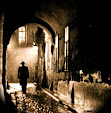
The famous Prater Wheel sequence from Carol Reed's The Third Man. As the story goes, the cuckoo clock line wasn't even in the script. It was added on set by Welles because he thought it helped the timing. Fifty years later, it's still one of the most memorable parts of the film.
Friday, December 19, 2008
Man On Wire (2008)

It’s no surprise that the end credits of Man On Wire list the main musical theme as the “WTC Heist Music.” After all, director James Marsh’s fantastic documentary about high-wire walker Philippe Petit is very much a heist movie, chronicling the planning, scheming, and intrigue involved in Petit’s 1974 attempt to walk a tightrope between the newly constructed World Trade Towers. Using disguises, fake names, falsified documents and months of meticulous planning, Petit and his accomplices managed to smuggle hundreds of pounds of equipment to the rooftops of the towers to engineer what the film's tagline calls “the artistic crime of the century.” It was an art heist in the grandest sense of the term, but rather than stealing a painting or a sculpture, Petit and his friends--identified in the film with espionage-inspired monikers like “the Australian” and “the Inside Man”--were stealing the opportunity to create their own absurd, sublime performance piece.
Marsh uses a number of excellently constructed reenactments to help portray the tension of the “heist,” which required the men to avoid roving security guards, at one point hiding under a sheet for hours while a guard made his rounds only feet away. Marsh never ignores the danger inherent in such a bizarre stunt, and he effectively uses the camera in his reenactments to give the viewer the feeling of being, as Philippe describes it, “on the top of the world.” (Lots of films have tried to recreate the danger of teetering on the edge of great heights, but Man On Wire is probably one of the few that will give its audience a true feeling of vertigo). Like Errol Morris, who’s made a career out of using reenactments in his docs, Marsh adds new levels of depth and artistry to the story with his cut scenes, which are often shot in grainy black and white, to the point that it's sometimes hard to tell what’s reenactment and what’s Petit’s own home movies, which are also used to great effect. There is no video of Petit’s stunning final walk between the towers, but Marsh’s deftness and the film’s pitch-perfect editing are such that you’re not likely to notice.

The story’s frenetic pace and the gripping subject matter are only enhanced by the interviews with Petit, an ebullient Frenchman and born raconteur whose poetic retelling of his own story is the most engrossing aspect of the film. As one of his accomplices says, “he draws you into his world” with his charm and creativity, which played a significant role in the successful completion of the heist. Consider how the men solved the problem of getting the wire from one tower to another: Petit examined a number of possibilities, from hitting a baseball tied to a rope to using remote control airplanes, but in the end they took the simple route and used a bow and arrow to fire a rope from one tower to another. It’s the kind of idea that anyone could come up with, but only a man crazy enough to walk a tightrope 1350 feet in the air would actually try. It’s the same attitude summed up by Philippe when he describes the formulation of his dream: “It’s impossible, sure. So let’s start working.”
While Marsh’s style and Petit’s personality succeed brilliantly in making Man On Wire compelling, an even bigger accomplishment is how quickly and completely they convince the viewer of the validity--the necessity even-- of what is essentially an absurd and pointless act. We see the beauty, the sublimity, and the artfulness that was inherent not only in the wire act but in the planning process, along with the overflowing love Philippe has for his craft, and we leave with a special gratitude for having received a gift we never even knew we wanted.
Tuesday, December 9, 2008
"There Has To Be Something Else Out There": Paranoid Park (2007)

Save for his forays into mainstream mediocrity with movies like Finding Forrester, Good Will Hunting, and his shot-by-shot remake of Psycho, Gus Van Sant is regarded as one of the more interesting and provocative directors in American film. His career of late, which has included the so-called “death trilogy” of Gerry, Last Days, and Elephant, has established him as a director with something to say-- an artist interested in exploring “big” subjects like school shootings or the enigmatic life of a legendary musician. Beyond anything else, Van Sant is known as a director who gets his audience involved in tough subjects. With this in mind, it’s strange that Paranoid Park, perhaps the best-reviewed film of his career, evokes such a non-reaction, has so little on its mind, and eventually elicits nothing more than an indifferent shrug when its over. While watching the movie I felt like I could identify with Alex, the disaffected, ever-boy teen protagonist at the center of the story, if only because I felt as alienated from and disinterested in his life as he does.
Oddly enough, this does not mean that Paranoid Park is a boring movie to watch, a criticism that is easily (and not altogether unfairly) leveled at Van Sant’s recent work. His fluidity and sensitivity as a director is on display in every frame of the film, and from the start he draws you into the world of Alex, a Portland high school student and skateboarder. Alex is dealing with problems that a lot of kids his age face-- parental divorce, a girlfriend who wants to get serious, the need for acceptance from his peers-- and he walks around with the same vapid, bored expression that can be spotted on the faces of teens in shopping malls and skate parks across the country. But Alex, as he explains himself in an elliptical, inarticulate narration, is troubled by a bigger problem-- one that involves the grisly murder of a security officer in a train yard, and has the police showing up at his high school to question he and his fellow skateboarders.
I’ve frequently heard Van Sant’s style of late compared to Italian Neorealism, the school of cinema in the 50s that sought to portray ordinary life in an unaltered, unadorned fashion (think De Sica's The Bicycle Thief). Some critics have called Paranoid Park, with it’s unprofessional actors (Van Sant found lead actor Gabe Nevins and others on MySpace) and long takes, the heir to this style, but they’re off the mark. After all, people in normal life don’t get involved in murders that often, and a director who wants to shoot in an unadorned style doesn’t hire Christopher Doyle, longtime collaborator of Wong Kar Wai, as his cinematographer. In actuality, Van Sant seems to have hit on a newer, more original approach here, one that attempts to approximate as closely as possible the feeling of being inside a character’s head. Van Sant and Doyle, along with Rain Li, who provides a number of excellent skate scenes, fill the film with an abundance of stylistic “noise”-- from cutaways to super-8 footage of skaters in sewer pipes, to inexplicable soundtrack shifts from Billy Swan to Beethoven, and bizarre sound effects and synchronicities in the audio track-- that helps to show the rambling and panicked dialogue going on in Alex’s troubled mind.
It’s a stylistic achievement, and because it works so well the filmmakers are able to string the viewer along on a thin story and character for longer than they have any right to. But after the first half of the film I started wanting more from Alex than his inarticulate stuttering and blank expression. Van Sant undoubtedly directed Nevins to act this way in order to add a level of universality to the character, to turn Alex into a blank slate for the audience to project onto, but at a certain point a little expression, a little spark of personality here and there, would’ve done wonders for the film.
If this alienation were confined to the character I might have been able to get by it, but Van Sant insists on including the same level of nebulousness and universality to his theme and story as well. What we end up getting by the end of Paranoid Park feels like half a story: kid accidentally kills cop, is troubled by it, and... the end. We never get a real conflict, a real theme, or a resolution. What we get is a rigid character study of the most uninteresting character imaginable. Look, I’m no cinematic puritan. By no means do I demand to be presented with a 3-act structure and a theme at every movie I see. But I do demand that I be involved, if not in the character than at least in the things that happen to them. So I could have enjoyed Paranoid Park as some kind of modern-day Crime and Punishment (which many critics have compared it to), or as a Camus-esque study of randomness and chance a la The Stranger-- but we never get enough evidence from the story to make either such leap. The best explanation I can give is that Alex-- whose father is absent from the home-- is desperate for male attention to the point that he’ll blow off his girlfriend or commit a crime in an attempt to be accepted as one of the guys, and that kind of pseudo-psychology is about the least interesting path the film could’ve taken. At one point in the story Alex tells his friend Macy, an intelligent young girl who is the most interesting character in the film, that he feels like there’s another world beyond everyday life, that “there has to be something else out there.” That’s the way I felt, too, and I wish Van Sant had something more to show me beyond banal surfaces and his own technical skill.
Still, as problematic as Paranoid Park’s story and character are, I would be lying if I said it wasn’t intriguing to watch. Van Sant’s technical skill is considerable, and if you’re into that kind of thing it might get you through the movie-- it’s only when you think about it afterward that everything falls apart. The style on display here is exquisite, and leaves you wondering where a guy with such considerable talent will go next (the first step seems to be a move back toward the mainstream with Sean Penn in the Oscar frontrunner Milk). Still, I can’t imagine it is much more than Van Sant’s skill at weaving together image and sound that has made Paranoid Park so well-received. It is strange to see how he has evolved as a filmmaker over the last several years. Once, I would’ve considered him a director who made thematically interesting but ultimately dull films. Paranoid Park is not dull by any means, but when it ends it leaves you with woefully little to think about.
Subscribe to:
Posts (Atom)