Friday, April 17, 2009

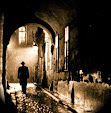
“What a Piece of Work is a Man”: Withnail and I (1987)


The cult comedy Withnail and I finds Richard E. Grant and Paul McGann as two debauched and unemployed actors in 1969 England who head out to the countryside to recuperate from their latest binge and get started on the next one. Broke and with few prospects as thespians, the duo manages to dupe Withnail’s (Grant) gay uncle Monty in letting them use his cottage for the week, and take off with the intention of “getting out of it” for a while. What follows is a comedy of errors and epic bad behavior, as the two insult the local townsfolk, get attacked by bulls, and go fishing with shotguns, all while consuming heroic amounts of “the finest wines available to humanity.”

Withnail and I
is certainly one of the all time great films about drinking and excess, but where it works where movies like Fear and Loathing in Las Vegas fail is in the relationship between the two lead characters. There is not a false moment in the film, thanks to an eminently quotable script from writer/director Bruce Robinson (How To Get Ahead In Advertising), and brilliant performances from McGann and Grant as the two leads. Grant is as good as he’s ever been as the mercurial, cowardly, and somehow entirely likable Withnail, a ferocious ball of energy and insults that seems to have stumbled into the film straight out of a Shakespeare play. Described as a man “incapable of indulging in anything but pleasure,” Withnail is selfish, manipulative, and bombastic, and also one of the all time funniest screen characters. Scene by scene, Grant never delivers a line that isn’t pitch perfect, and he’s matched by McGann as Marwood, the “I” to his Withnail, who is the more level headed of the two, but is really only marginally less insane than his friend.

Robinson’s shooting style, as he has said himself in interviews, is pretty mediocre, but his writing is so good that you’re not likely to care. The real pleasure here (as in last year’s In Bruges, which probably owes a debt to this film) comes from watching great actors deliver great lines, and for such a small story, this works just fine. There is very little plot to be found here, just excellent characters, including Ralph Brown as the duo’s drug dealer, Danny. Brown is probably best known as the roadie Del Preston from Wayne’s World 2, and it seems that his character in that film was nothing if not a personal homage to his character here, a long-haired, philosophy-spouting hippie who makes bizarre claims like “all hairdressers are in the employment of the government” and constantly argues with Withnail over who can handle the most drugs. Richard Griffiths is also excellent as Uncle Monty, a wealthy aesthete with a penchant for food and fine wines, who shows up unexpectedly at the cottage with a single-minded obsession to seduce the hapless Marwood.

Along with the performances and great dialogue, what really makes Withnail and I so enjoyable is the theme of friendship that runs throughout. Everyone has known a person like Withnail at some point or other, and we can all identify with the neurotic Marwood. So it's easy to see how much their two personalities compliment and play off one another, and we come recognize how much each man, especially Withnail, needs the other. It’s no surprise that the film is set in 1969, at the very end of what Danny calls “the greatest decade in history,” because Withnail and I is in many ways a film about transition from one period of life to another, and the ways that certain habits and people have to be left behind in the process. The two characters spend most of the film in stasis, perpetually drunk and starving, and as that begins to change, so too does their friendship. This adds a small element of tragedy to what is otherwise a comic tale, and only helps make the film’s uncertain, bittersweet ending all the more perfect.

Tuesday, April 14, 2009

Synecdoche, New York (2008)


Synecdoche, New York is the directorial debut of Charlie Kaufman, the wildly inventive screenwriter behind films like Being John Malkovich and Eternal Sunshine of the Spotless Mind. Over the course of six scripts, Kaufman has developed a trademark style of exploring familiar themes (the creative process, romantic love) while at the same time playing with structure and introducing bizarre plot points like a portal that leads to the head of another person, or a machine that can erase painful memories. So it’s no surprise that Synecdoche, New York is a serpentine head trip of a movie. In fact, there’s no doubt that this is his most ambitious project to date. It’s a behemoth of a film, charting a character through most of his existence and tackling some of the big questions about life and death. What is surprising is how little pathos or liveliness it has, and for a film with such gigantic ambition and scope, how empty it ends up feeling. Kaufman’s gift for exploring the limits of narrative and structure is certainly alive and well, but his script never delivers on enough substance to make it a trip worth going on.

The film ostensibly follows Caden Cotard (Philip Seymour Hoffman), a theater director known for audacious projects like a version of Death of a Salesman performed with all young actors. His life begins to literally fall apart when his artist wife (Catherine Keener) leaves him and takes his daughter to Berlin, and his health problems start multiplying at an alarming rate. Convinced he’s on the verge of death, Cotard unexpectedly receives a MacArthur Fellowship, the so-called “Genius Grant,” and resolves to use his new financial freedom to put on a play that will be “big and true and tough,” a project to sum up his life experience. Renting out a gargantuan warehouse and employing thousands of actors, he begins to build (over the course of years) a giant set replica of the outside world, reenacting events from his life and transforming them into a magnum opus of love, loss, and death.

Kaufman’s script is chock full of references to famous authors and theorists like Baudrillard (Cotard considers, not surprisingly, calling his play “Simulacrum”), Rilke, and Kafka, so it's little wonder that the mood here is one of pervasive dread and morbidity. This is echoed by Kaufman’s shooting style, which is all dark and seedy urban landscapes and dreary apartment buildings (in a nod to Luis Bunuel’s surreal style, one character’s house is perpetually on fire), a decay that seems to mirror Cotard’s forever-ailing body. But Kaufman seems to have little of an eye for interesting composition, and it becomes obvious that whatever spark his previous films had was courtesy of Spike Jonze and Michel Gondry. Similarly, his pacing is unbelievably awkward and mistimed. Every time the story begins to gain any momentum, another twist occurs, or a new level of narrative is introduced (I’m still trying to figure out the relevance of the sequences in Berlin), a tactic that does little for the meta style he’s trying to cultivate, and only succeeds in repeatedly taking the viewer out of the story.

As Cotard, Hoffman exudes a certain kind of exhausted melancholy in every scene (one could argue that he does this in almost every film he’s in, actually), and he does it well, but his character ultimately becomes a caricature of all the worst parts of the creative personality to the point that we stop caring about his latest loss or health problem. Meanwhile the periphery characters, among them Michelle Williams and Emily Watson as two of Cotard’s love interests, seem less like real people and more like stage props for Hoffman’s character to manipulate and arrange in his project. This may or may not be intentional, but there’s no doubt that it alienates the audience to the point that the movie becomes relentlessly tiresome.

This is too bad, because on a scene by scene basis, there is actually a lot to like here. The introduction of Tom Noonan as an actor playing Cotard in the play makes for some of the film’s best moments, and the details of how the play is put together inside the warehouse are fascinating, with Hoffman walking through a maze of different sets and giving his legions of actors direction. Structurally, these parts of the film (probably Kaufman’s career, in truth) owe a debt to the writer Jorge Luis Borges, whose famous short story “On Exactitude In Science” describes an attempt to make a map with the scale of a mile to a mile. Similarly, Cotard becomes so busy recreating his actual life in his labyrinthine back lot that he forgets to live it, to the point that the two become hopelessly intertwined. This idea is interesting enough, but Kaufman fails to set his focus on any one subject enough to fully explore it, and as his ideas pile up one another, the whole construct eventually collapses under the weight of its own cleverness.

There’s no doubt Synecdoche, New York is full of enough legitimately good ideas for ten feature films, it’s just that Kaufman fails to meld them into anything truly compelling. There’s no argument that he’s an interesting man and an inventive writer, but it seems like beneath all the wordplay, self-reflexivity, and narratology, he’s just not a very effective or natural storyteller. His movies, which tackle some of the big questions of life and what it means to be human, are always paradoxically drab and lifeless, like an academic whose ideas are beautiful but whose own personality is relentlessly bland. Taken as individual snippets, many of the scenes in Synedoche, New York work beautifully. For example, the few sequences featuring the always excellent Hope Davis as Cotard’s therapist hit just the right note of absurdity, and provide the film with some of its few moments of levity, and a late scene that finds an actor (playing a priest) expounding on the nature of despair is one of the most heartbreaking things I’ve seen. But none of this ever gels into anything that feels complete or whole, and while I’m willing to concede that even this conceit might fit into the fractured framework of Kaufman’s script (his style is so meta that it gets hard to legitimately criticize anything), it never succeeds in making Synecdoche, New York anything more than an oddly alluring mess of a movie.

Friday, April 3, 2009

The Debate Over Neo-Neo Realism


Soon after posting my review of Frozen River I came across this article from IndieWire about an argument going on between film critics A.O. Scott (NY Times) and Richard Brody (New Yorker) over an article Scott wrote about the “Neo-Neo Realism” that he claims is at work in a lot of American independent films like Chop Shop, Wendy And Lucy and the new film Goodbye Solo. Scott’s basic argument is that these movies, which generally use non-professional actors and tell simple stories about working class people, are the kinds of films that America is currently starved for, and that these filmmakers are carrying on in the tradition of Italian Neo-Realist directors like DeSica, Visconti, and early Federico Fellini. Hence the redundant name of his theory.

Brody’s lengthy response argues that Scott is “making too much” of these films and that the examples he chooses to illustrate his theory are too disorganized to add up to anything concrete. “I think it rests on questionable premises and reaches dubious conclusions,” he says. In the pedantic world of film websites and movie critics, it seems that this little argument has already grabbed a lot of attention, with different critics falling on one side or the other of the debate and wasting a whole lot of time talking about how we’re supposed to talk about movies.

Since I brought up my own little theory in the review about how movies like Chop Shop and Frozen River are operating within a wider framework, I thought I should chime in on this and give my opinion on who’s right in this debate. But after reading both of their essays, I can’t say that either one of them has much of a solid argument to back up their claims, and anyone with the least bit of film knowledge should be able to poke all kinds of holes in their theories.

For example, Brody’s objection to Scott seems to be all semantics, based around whether or not films like Killer Of Sheep are actually Neo-realist, and whether there are better examples of current films to make an argument around. As Scott said in his eventual response, “this is Mr. Brody’s way of saying that he and I like different movies.” Arguing over what movies best fit a concept that you don’t even accept as true doesn’t get you very far. This is not to mention the number of bizarre claims Brody makes near the end of his article, like when he says that the films mentioned are no more realistic than The Curious Case of Benjamin Button, a claim that is patently absurd. No matter who you are or what you think about the films in question, I think you’d have to agree that a film about a woman who loses her dog, like Wendy and Lucy, is far more rooted in reality than one about a man who is born old and ages in reverse. There’s just no argument there.

This is not to say that I agree with Scott either. His argument about these films is a little too loosely defined for my tastes, since he never seems to make a distinction about whether he’s talking about how these movies are made (handheld camera, location shooting, non-professional actors), or the stories they tell (working class struggles, social issues), or both. In any case, any two of the films he mentions have only a couple of these aspects in common. In this regard, I would agree with Brody that Scott is a bit too hasty to give a name to a movement that hasn’t really developed any recognizable characteristics.

And this is all without getting into the whole philosophical argument about what it means to be “realistic” on screen and whether or not it’s even a goal to aspire to. As Brody mentions, all the early practitioners of Neo-Realism eventually abandoned it in favor of more conventional styles that would allow them to tell bigger, deeper stories by using all the technological tools at their disposal. This was certainly true of Fellini, who abandoned the neorealist style in order to more deeply explore the psychological aspects of his characters. Movies are about telling stories, plain and simple. If a director thinks one style is best suited to telling a specific tale, or if it allows them to shoot it more quickly or cheaply, then they should use it. They shouldn’t worry about whether they’re going to be classified one way or another, or limited by what label they are given. That’s the kind of territory you venture into when you start trying to name a style before it’s even really developed.

Which brings me back to Frozen River, Chop Shop, and Shotgun Stories. The only thing I can really see linking these films together is a desire to document parts of American culture that are otherwise ignored. Films from Hollywood don’t exist in any American culture. They exist in a streamlined, homogenized movie culture that they all feed on and build up to the point that it can stand in for the real thing. America is a big country, and just because everyone shops at Target and Wal-Mart it does not mean we all live in the same culture. If there is any kind of a movement going on in film right now, it just might be the desire to break away from the construct and start documenting the culture beyond New York and Los Angeles. But beyond this impulse, which seems to be presenting itself in countless forms, I have to agree with Brody that there isn’t anything closely enough resembling a new style to be worth classifying, especially not with a name as pretentious and loosely defined as “Neo-Neo Realism”.

Frozen River (2008)


Along with last year’s Chop Shop and Shotgun Stories, writer/director Courtney Hunt’s Frozen River is part of what seems to be an emerging trend in American film to document life as it plays out in specific regions of the country that remain untouched by the prevailing culture. These films seek to show the vast differences in life and experience in the U.S. by documenting parts of the country that might seem utterly foreign to the typical viewer. In Chop Shop it was New York City’s Iron Triangle, an industrial neighborhood in Queens filled with scrap yards and auto repair shops, and in Shotgun Stories it was decaying small-town Arkansas. Here, it is New York’s North Country, just near the Canadian border and a Mohawk Indian reservation, a frozen, gritty backdrop where everything seems dilapidated and on the verge of falling apart.

Ray Eddy (Melissa Leo), a cashier at a dollar store, is struggling to raise two sons and preserve a marriage with her perpetually absent husband, a drug and gambling addict who at the film’s start has disappeared with the money set aside for the family’s new double-wide trailer. While searching for him around town, Ray meets Lila Littlewolf (Misty Upham), a Mohawk woman with a history of smuggling. Since both have fallen on hard times, the two soon begin transporting illegal immigrants into the U.S. by driving them across the frozen St. Lawrence river between two Indian reservations. It is dangerous and illegal, but it pays very well, and Ray sees it as the only way that she’ll be able to give her children a new home.

Like Chop Shop or Shotgun Stories, Frozen River avoids sermonizing about social issues in favor of focusing on the plight of its characters. Hunt could have used her film as a soapbox to decry American immigration policy or the treatment of Indians in the U.S., but she wisely lets the characters and their story speak for themselves. At its heart, this is a very simple film about the lengths a mother will go to to protect her children. Both Ray and Lila, who is estranged from her baby boy because of her criminal history, are only trying to make enough money to take care of their own. In Ray’s case it is only the simple, sensible dream of trying to get a new trailer that leads her to take bigger and more extreme risks as the story progresses.

As Ray, Melissa Leo gives what is undoubtedly one of the most engaging and unsentimental performances of last year. She’s a consistently strong actress who has appeared in countless projects over the years, but she seems born to play this role, and deserved the Oscar nomination she got for it. Her Ray is a tough, world-weary woman has been beaten down by life but refuses to give up, and is willing to go to the most extreme lengths to preserve her dignity and that of her family. Leo’s performance works so well because she never once asks for the audience’s pity-- she is simply a person doing what she has to do to survive. Misty Upham is similarly strong as Lila, who couldn’t be more different from Ray, but who bonds with her over the need to care for and protect her own child.

Hunt shoots all this in a blue tinted hue that lends itself to the cold and unforgivable landscape of the North Country. The film was shot on location, and the environment, as in the other films, is as much a character as the people who inhabit it. Here it is all trailers and deteriorating buildings, bitter cold and mud, an environment as inhospitable as the economic situations the characters find themselves in. The smuggling scenes are incredibly taut and well-realized, with the characters crossing the river’s thin layer of ice under cover of darkness and transporting illegals back across in the trunk of their car. It’s a deceivingly simple process that Hunt manages to keep adding new depths and higher stakes to, to the point that one of the final crossings manages to be one of the most nerve-wracking scenes of last year.

Despite all this, Frozen River never comes to close to being a thriller, just as it avoids being a message movie. Everything is too grounded and focused on Leo’s performance and the struggle of these characters. Because her goals are so modest and the stakes to reach them so high, Ray’s struggle ultimately has tragic implications. This, too, is a through line that seems to run through these new films. In Chop Shop, it’s the young boy’s dream of opening a food cart, in Shotgun Stories it’s the broader need to provide for family and come to terms with one’s own past. In each case the stories tell about a person’s struggle to improve their station in life, only to be be thwarted by outside forces that are forever conspiring against them. (I'm still waiting to see Ballast and Wendy and Lucy, both of which seem to be of this same ilk). It’s a story we've seen time and again, (The Bicycle Thief comes to mind), but these new films, especially Frozen River, have breathed new life into it by linking it to parts of American culture that previously have not been documented.

Tuesday, March 17, 2009

Rachel Getting Married (2008)


2008’s Rachel Getting Married is a drama about a group of upper-class New Englanders coming to terms with their past during the wedding of the family’s eldest daughter. It’s a movie where the cliches are rolled out one after another. Parental divorce, addiction, sibling rivalry, a death that’s never been properly confronted-- it’s all here, and very little of it is even presented in any way that complicates what we’ve already come to expect from this type of film. The only unexpected thing about Rachel Getting Married, then, is how unusually well director Jonathan Demme and screenwriter Jenny Lumet (daughter of Sydney) make these old standards operate within the framework of their story. For its first half, the movie almost works well enough to restore faith in the power of the dysfunctional family melodrama, but it quickly loses steam an ends up more like an updated version of Ordinary People with music. Lots and lots of music.

The story, as expected, is pretty simple. Kym (Anne Hathaway), a young woman with a history of drug abuse, is let out of her latest rehab institution for the weekend to attend her sister Rachel’s wedding. Conflict ensues, of course, and over the course of a very long few days a number of familial issues are brought to light and confronted. Where the movie works where so many of its kind fail, at least in the early running, is in the way that the conflict manifests itself. When Kym shows up at the house, we expect her to barge in like a force of nature and immediately start shaking things up. But the filmmakers don’t go for these kinds of easy setups. Things start out normal, and Kym, though she clearly has problems, is actually rather pleasant and likable, and even her relationship with Rachel seems pretty stable. Her issues are much more insidious, though, and it quickly becomes obvious that Kym resents the attention being showered on her sister. This tension finally comes out during a toast at the rehearsal dinner that, though a bit over the top, is notable for being at the same time relatively innocuous and unbelievably hard to watch.

Scenes like this one and the epic argument that follow it back at the family’s house are where Rachel Getting Married is at its best. Rarely does the conflict in these types of films arise so naturally and organically out of the situations. Usually it devolves into actors competing to see who can deliver their lines with the most venom, but here the arguments feel all too real. A lot of credit should go to Hathaway, who wisely holds back enough that Kym never feels too much like a caricature, but I was also very impressed with Rosemarie DeWitt as Rachel and Bill Irwin as the sisters’ mild-mannered father Paul, who has the unenviable role of playing referee in most of the conflicts. The scenes between the family are unbelievably tight in their execution, but never in a way that seems over-rehearsed, and most of all, the script lets the story come out of these characters and the ways they clash rather than vice versa.

Demme films all this in that jittery handheld video style that I have time and again railed against, but here I have to admit that it adds an element of immediacy that might not have been there otherwise. He just might have hit on the perfect use of the handheld style (something that John Cassavettes realized 30 years ago), and it helps to add a fluidity to scenes that could have come off all too much like theater.

The problem is that beyond this opening conflict the film has very little to offer beyond reverting to a number of Lifetime-channel cliches and confrontations that, if not delivered by such superior actors, would seem laughably juvenile. Near the end of the film, things get rather repetitive, and it eventually becomes frustratingly obvious that what we have here is the content of an excellent short film stretched and padded to feature length. Demme tries to combat this by including several documentary-style scenes of the wedding activities. There are toasts, speeches, and dinners, but outside of a few cut-ins of Kym looking troubled, they add absolutely nothing to the actual story. When it came time for the actual wedding ceremony I was truly hoping that he would cut around it. No such luck.

And then there’s the music. Scene after scene of it, throughout the movie. It’s all played by wonderfully able musicians in a number of genres, but beyond making me wonder where I could get a hold of some of these songs it has no effect whatsoever on the experience of the film’s story. Demme made Stop Making Sense. We know he can shoot the hell out of a musical performance, but in the context of the film these otherwise cool scenes are nothing more than filler.

Maybe ditching these scenes and extending the actual story of Rachel Getting Married would have made it one of the more hard-hitting films of last year, and maybe it would have watered everything down to the point of unwatchabilty. It’s hard to say, but the point is that Demme and Lumet seemingly didn’t try, they just got in contact with some good musicians and let them go crazy. Watched alone, I’d wager that the few good scenes of familial conflict rank among the best of last year. They are heartbreakingly incisive, and hit all the right notes that you look for and so rarely get in a movie like this. But in the film’s second half everything just sort of devolves into a half-baked concert film/wedding documentary. All these scenes pile on one another to the point that by the end of Rachel Getting Married, you feel as though you’ve actually attended the wedding, and the supposed family drama seems less like the actual story and more like an embarrassing scene you stumbled upon while you were waiting to get another drink.

Friday, March 13, 2009

Let The Right One In (2008)


The expertly constructed Swedish vampire film Let The Right One In is one of those rare movies that is more notable for what it suggests to its audience than what it actually shows them. Director Tomas Alfredson’s film just may be the best shot movie of last year, and the style he employs is at times so slight and subtle that the smallest look or gesture is able to speak volumes about its characters and their bizarre relationship. This is certainly a horror movie, faithful to the mythology of the vampire and with several striking scenes of violence, but at its heart it is one of the more keenly observed films about human relationships to come along in some time.

The story follows 12-year-old Oskar, a young boy living in a suburb of Stockholm in 1982. Oskar is an outsider at his school, where a group of bullies is constantly terrorizing him, and even more alienated from his parents, who are separated and seem to have very little to do with him. He is seemingly alone in the world, until he meets Eli, a girl his age who has just moved in next door. Eli is certainly strange-- she doesn’t go to school and only seems to come around at night, and her arrival coincides with a series of grisly murders in around the town-- but Oskar is happy to have a friend, and eventually asks if she’ll be his girlfriend. She hesitantly agrees, as long as he realizes that she’s “not really a girl.” Soon the two are spending as much time together as they can, and Eli is coaching Oskar on how to fight back against his tormentors.

Oskar’s reaction to learning that Eli is a vampire is certainly unexpected, and moves the story toward its more surreal final third, but it works because of how well-constructed the dynamic between the two is, and how natural their interactions have been to that point. The majority of the credit should go to the wonderful young actors playing the duo, Kare Hedebrant and Lina Leandersson, but the film’s script, adapted by John Ajvide Lindqvist from his novel, is also spot on, and features some of the most beautifully simple dialogue I’ve heard in a while. Take the oddly funny scene where Oskar, upon learning that Eli is indeed a blood-drinking vampire, asks her how old she really is. “I’m twelve,” she insists, “but I’ve been twelve for a very long time.”

Director Tomas Alfredson’s style is impeccable, and is a big part of what makes the film’s meaning so rich and multilayered. He makes use of a largely static camera to capture the unusually foreboding backdrop of the town, often using long shots to let the atmosphere swallow up the characters. After watching the film, one can’t imagine the Swedish landscape, with its snow covered streets and pitch-black night skies, being shot any differently. The comparison to fellow Swede Ingmar Bergman is probably too easy, but Alfredson’s camera seems to capture the film’s landscape and the faces of its characters with the same kind of emotional intensity that makes films like Winter Light so memorable, and like Bergman he delivers several beautifully composed shots that will stay with the viewer long after the film is over. His deliberate pacing is also Bergman-esque, but it is punctuated by some staggeringly brutal scenes of violence that rival some of the horror genre’s masters in their originality and intensity. Alfredson handles these scenes with a matter-of-fact kind of style that lends an elusive quality to the violence. Avoiding the quick cuts and shaky camera that plague so many American horror films, he uses long shots in these scenes to place the viewer at a distance and give the odd feeling of being a witness to the killings, which unfold with the speed and ferocity of an animal attack.

Outside of these scenes, the pacing and style of the film is quite subdued. Alfredson feeds the audience very little through dialogue, and his directing style might as well be a master course on how to tell a story visually. Every scene is altered and the surface meaning complicated by a simple shot or a cut scene, and as the film progresses we begin to see that the seemingly innocent relationship between Oskar and Eli is becoming more and more clouded.

Still, in the end it is this relationship, in all its complexities and terrifying implications, that makes Let The Right One In work so well. Eventually, we begin to see that the title doesn’t just refer to the old lore that a vampire must be invited into someone’s home before they can enter it, but also to the interaction between the two main characters, who are slowly letting another person truly know them after a life of feeling alone. Oddly, and despite all the gothic trappings that come along with being a vampire story, Let The Right One In is at its heart an elegantly simple film about two outsiders finally finding a person they can relate to, and it’s this emotional core, twisted though it may be, that grounds the film and makes the fantastical elements seem all the more natural.

TRAILER:

Monday, March 2, 2009

Choke (2008)


Choke is the latest adaptation of a novel by Chuck Palahniuk, the author of Fight Club. Palahniuk is known for his mind-bending stories and his black humor, so it’s no surprise that the plot of Choke is appropriately bizarre, following sex addict Victor Mancini (Sam Rockwell), who when he isn’t looking for his next hook-up is trying to work his way through the twelve steps (he’s been stuck on number 4 for a while), though it seems that every time he attends a meeting he ends up slipping away to a closet or a bathroom with the girl he’s supposedly sponsoring. Victor works as a “historical interpreter” at a colonial theme park by day and as a sort-of con man by night, intentionally choking in restaurants and hoping to be saved by rich people who, in order to “relive their savior experience,” will keep in touch and sometimes even send money. He does all this to help pay for his long-suffering mother (Anjelica Huston) to stay in a care facility for the mentally ill.

If that schizophrenic plot summary doesn’t make it clear enough, Choke is a movie where the plot is constantly moving in frustratingly nonsensical, thematically divergent directions (and that’s leaving out the subplots). Maybe in the book Palahniuk makes it all work (he’s always been on my “life is too short to read...” list), but on screen the story practically screams with dissonance. This movie, written and directed by character actor and first-time filmmaker Clark Gregg, is simultaneously a comedy, an addiction movie, a “head trip” movie a la Fight Club, and a drama-- which would be fine, if any of those elements cohered into anything remotely resembling a watchable story. There are a few clever scenes, most of which take place at the colonial theme park and concern Victor’s boss Charlie (played by Gregg), who is a stickler for 1700s accuracy, but after a funny start the movie becomes more droll than anything, and like all Palahniuk stories, seems to try too hard to be disturbing and unusual. By late in the film, even a scene where a woman asks Victor to “pretend” to rape her seems like nothing more than a pitiful attempt to get nervous laughter.

The film falls even flatter as a drama, suffering from that same inertia-destroying compulsion to revert to childhood flashbacks to explain every little adult problem that has plagued and destroyed so many an otherwise adequate film. And as for the plot-twists, they seem very forced and very obvious, as though the movie is trying to be like Fight Club in that “nothing is what it seems" sort of way despite lacking any of that film’s energy or inventiveness.

Rockwell is growing on me as an actor, and he’s perfectly fine as Victor, bringing just the right kind of sarcastic detachment and absurdity to a character that would otherwise be very hard to sympathize with. The real disappointment is Kelly MacDonald, who has been almost universally good throughout her career, especially in 2007’s No Country For Old Men, but who here seems to be so obviously acting that it becomes almost painful to watch as she recites line after line as though it’s written on a cue-card off screen. A late plot twist slightly exonerates her, but even this (which anyone should be able to spot a mile away) would have worked better if she had been even the least bit convincing in her role. Angelica Huston, as always, displays more acting skill in a few scenes than most do in their whole career, but after suffering through The Darjeeling Limited, I’m starting to get sick of seeing her show up as the eccentric mother in movies that try painfully hard to be offbeat. She could do much better.

In many ways, I’ve started to see Palahniuk’s Fight Club as a good movie that was bad for movies in general. Ever since Tyler Durden was introduced to the world, every other film that comes out has some last-minute rewrite of the story, where everything in the previous 90 minutes is rendered moot and useless by the sudden revelation that “it was all a dream” or “he was dead all along.” Choke doesn’t pull the rug completely out from under its audience to that degree, but it’s still ultimately a cheat, the same kind of hustle that Victor pulls on unsuspecting restaurant patrons. If Fight Club was the high point of Palahniuk’s trademark style brought to life on screen, then let’s hope that Choke is as low as it gets.