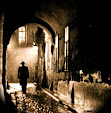
The famous Prater Wheel sequence from Carol Reed's The Third Man. As the story goes, the cuckoo clock line wasn't even in the script. It was added on set by Welles because he thought it helped the timing. Fifty years later, it's still one of the most memorable parts of the film.
Saturday, December 20, 2008

Friday, December 19, 2008
Man On Wire (2008)

It’s no surprise that the end credits of Man On Wire list the main musical theme as the “WTC Heist Music.” After all, director James Marsh’s fantastic documentary about high-wire walker Philippe Petit is very much a heist movie, chronicling the planning, scheming, and intrigue involved in Petit’s 1974 attempt to walk a tightrope between the newly constructed World Trade Towers. Using disguises, fake names, falsified documents and months of meticulous planning, Petit and his accomplices managed to smuggle hundreds of pounds of equipment to the rooftops of the towers to engineer what the film's tagline calls “the artistic crime of the century.” It was an art heist in the grandest sense of the term, but rather than stealing a painting or a sculpture, Petit and his friends--identified in the film with espionage-inspired monikers like “the Australian” and “the Inside Man”--were stealing the opportunity to create their own absurd, sublime performance piece.
Marsh uses a number of excellently constructed reenactments to help portray the tension of the “heist,” which required the men to avoid roving security guards, at one point hiding under a sheet for hours while a guard made his rounds only feet away. Marsh never ignores the danger inherent in such a bizarre stunt, and he effectively uses the camera in his reenactments to give the viewer the feeling of being, as Philippe describes it, “on the top of the world.” (Lots of films have tried to recreate the danger of teetering on the edge of great heights, but Man On Wire is probably one of the few that will give its audience a true feeling of vertigo). Like Errol Morris, who’s made a career out of using reenactments in his docs, Marsh adds new levels of depth and artistry to the story with his cut scenes, which are often shot in grainy black and white, to the point that it's sometimes hard to tell what’s reenactment and what’s Petit’s own home movies, which are also used to great effect. There is no video of Petit’s stunning final walk between the towers, but Marsh’s deftness and the film’s pitch-perfect editing are such that you’re not likely to notice.

The story’s frenetic pace and the gripping subject matter are only enhanced by the interviews with Petit, an ebullient Frenchman and born raconteur whose poetic retelling of his own story is the most engrossing aspect of the film. As one of his accomplices says, “he draws you into his world” with his charm and creativity, which played a significant role in the successful completion of the heist. Consider how the men solved the problem of getting the wire from one tower to another: Petit examined a number of possibilities, from hitting a baseball tied to a rope to using remote control airplanes, but in the end they took the simple route and used a bow and arrow to fire a rope from one tower to another. It’s the kind of idea that anyone could come up with, but only a man crazy enough to walk a tightrope 1350 feet in the air would actually try. It’s the same attitude summed up by Philippe when he describes the formulation of his dream: “It’s impossible, sure. So let’s start working.”
While Marsh’s style and Petit’s personality succeed brilliantly in making Man On Wire compelling, an even bigger accomplishment is how quickly and completely they convince the viewer of the validity--the necessity even-- of what is essentially an absurd and pointless act. We see the beauty, the sublimity, and the artfulness that was inherent not only in the wire act but in the planning process, along with the overflowing love Philippe has for his craft, and we leave with a special gratitude for having received a gift we never even knew we wanted.
Tuesday, December 9, 2008
"There Has To Be Something Else Out There": Paranoid Park (2007)

Save for his forays into mainstream mediocrity with movies like Finding Forrester, Good Will Hunting, and his shot-by-shot remake of Psycho, Gus Van Sant is regarded as one of the more interesting and provocative directors in American film. His career of late, which has included the so-called “death trilogy” of Gerry, Last Days, and Elephant, has established him as a director with something to say-- an artist interested in exploring “big” subjects like school shootings or the enigmatic life of a legendary musician. Beyond anything else, Van Sant is known as a director who gets his audience involved in tough subjects. With this in mind, it’s strange that Paranoid Park, perhaps the best-reviewed film of his career, evokes such a non-reaction, has so little on its mind, and eventually elicits nothing more than an indifferent shrug when its over. While watching the movie I felt like I could identify with Alex, the disaffected, ever-boy teen protagonist at the center of the story, if only because I felt as alienated from and disinterested in his life as he does.
Oddly enough, this does not mean that Paranoid Park is a boring movie to watch, a criticism that is easily (and not altogether unfairly) leveled at Van Sant’s recent work. His fluidity and sensitivity as a director is on display in every frame of the film, and from the start he draws you into the world of Alex, a Portland high school student and skateboarder. Alex is dealing with problems that a lot of kids his age face-- parental divorce, a girlfriend who wants to get serious, the need for acceptance from his peers-- and he walks around with the same vapid, bored expression that can be spotted on the faces of teens in shopping malls and skate parks across the country. But Alex, as he explains himself in an elliptical, inarticulate narration, is troubled by a bigger problem-- one that involves the grisly murder of a security officer in a train yard, and has the police showing up at his high school to question he and his fellow skateboarders.
I’ve frequently heard Van Sant’s style of late compared to Italian Neorealism, the school of cinema in the 50s that sought to portray ordinary life in an unaltered, unadorned fashion (think De Sica's The Bicycle Thief). Some critics have called Paranoid Park, with it’s unprofessional actors (Van Sant found lead actor Gabe Nevins and others on MySpace) and long takes, the heir to this style, but they’re off the mark. After all, people in normal life don’t get involved in murders that often, and a director who wants to shoot in an unadorned style doesn’t hire Christopher Doyle, longtime collaborator of Wong Kar Wai, as his cinematographer. In actuality, Van Sant seems to have hit on a newer, more original approach here, one that attempts to approximate as closely as possible the feeling of being inside a character’s head. Van Sant and Doyle, along with Rain Li, who provides a number of excellent skate scenes, fill the film with an abundance of stylistic “noise”-- from cutaways to super-8 footage of skaters in sewer pipes, to inexplicable soundtrack shifts from Billy Swan to Beethoven, and bizarre sound effects and synchronicities in the audio track-- that helps to show the rambling and panicked dialogue going on in Alex’s troubled mind.
It’s a stylistic achievement, and because it works so well the filmmakers are able to string the viewer along on a thin story and character for longer than they have any right to. But after the first half of the film I started wanting more from Alex than his inarticulate stuttering and blank expression. Van Sant undoubtedly directed Nevins to act this way in order to add a level of universality to the character, to turn Alex into a blank slate for the audience to project onto, but at a certain point a little expression, a little spark of personality here and there, would’ve done wonders for the film.
If this alienation were confined to the character I might have been able to get by it, but Van Sant insists on including the same level of nebulousness and universality to his theme and story as well. What we end up getting by the end of Paranoid Park feels like half a story: kid accidentally kills cop, is troubled by it, and... the end. We never get a real conflict, a real theme, or a resolution. What we get is a rigid character study of the most uninteresting character imaginable. Look, I’m no cinematic puritan. By no means do I demand to be presented with a 3-act structure and a theme at every movie I see. But I do demand that I be involved, if not in the character than at least in the things that happen to them. So I could have enjoyed Paranoid Park as some kind of modern-day Crime and Punishment (which many critics have compared it to), or as a Camus-esque study of randomness and chance a la The Stranger-- but we never get enough evidence from the story to make either such leap. The best explanation I can give is that Alex-- whose father is absent from the home-- is desperate for male attention to the point that he’ll blow off his girlfriend or commit a crime in an attempt to be accepted as one of the guys, and that kind of pseudo-psychology is about the least interesting path the film could’ve taken. At one point in the story Alex tells his friend Macy, an intelligent young girl who is the most interesting character in the film, that he feels like there’s another world beyond everyday life, that “there has to be something else out there.” That’s the way I felt, too, and I wish Van Sant had something more to show me beyond banal surfaces and his own technical skill.
Still, as problematic as Paranoid Park’s story and character are, I would be lying if I said it wasn’t intriguing to watch. Van Sant’s technical skill is considerable, and if you’re into that kind of thing it might get you through the movie-- it’s only when you think about it afterward that everything falls apart. The style on display here is exquisite, and leaves you wondering where a guy with such considerable talent will go next (the first step seems to be a move back toward the mainstream with Sean Penn in the Oscar frontrunner Milk). Still, I can’t imagine it is much more than Van Sant’s skill at weaving together image and sound that has made Paranoid Park so well-received. It is strange to see how he has evolved as a filmmaker over the last several years. Once, I would’ve considered him a director who made thematically interesting but ultimately dull films. Paranoid Park is not dull by any means, but when it ends it leaves you with woefully little to think about.
Saturday, November 29, 2008
A New Take On Darko
Everyone who's seen Donnie Darko has their own ideas about what the movie is really trying to say, with director Richard Kelly's take being about the least interesting of all. This essay by film critic Jim Emerson (whose Scanners blog is a lot of fun and worth checking out) poses one of the most wild and oddly convincing theories I've come across. Was Gretchen Ross just a figment of Donnie's imagination? Does Donnie have something of an unhealthy preoccupation with his sister's love life? I'm not sure I agree completely with Emerson's take, but this is certainly one of the more intelligent discussions of the movie that I've read.
Thursday, November 20, 2008
Happy Anniversary
The blog turns one year old today. I'm the first to admit that 60 posts over the course of twelve months is a pretty weak output, but I'm going to try and start paying more attention to this thing. Regardless, thanks for reading, and rest easy with the knowledge that I'll be around for another year to tell you why your favorite movie sucks.
Monday, November 17, 2008
Parker and Stone's Mormon Musical
The internets are saying that Trey Parker and Matt Stone are putting together a Broadway show about Mormonism simply titled "Mormon Musical." If it's half as good as the "All About Mormons" episode of South Park, then it will be a work of pure genius.
"One Shot. One Kill.": Charting the Trajectory of the Marksman in Shooter(2007) and Sniper (1993)

(consider this notes for something much more interesting that I'll never get around to writing)
The only pleasure to be derived from 2007’s Shooter is how often and satisfyingly it delivers on exactly what the viewer expects to happen. There are no surprises here. When a soldier in the opening scene shows Mark Wahlberg a picture of his wife, we expect he’ll be dead within five minutes, and he is. When Ned Beatty shows up as a folksy career Senator, we immediately expect him to be corrupt, and so he is. When a rookie FBI agent (played by the excellent Michael Pena) starts researching the assassination attempt at the center of the plot, we expect he’ll uncover a vast conspiracy within the bureau, and he does. Even the details of the conspiracy itself are half-assed and tired (not surprisingly, it involves oil). What keeps the viewer from writing the film off as yet another generic action film is how skillfully and viscerally director Antoine Fuqua handles all the cliches, and how much fun the actors (especially Beatty and Danny Glover) seem to be having going through the motions.
Wahlberg stars as the absurdly named Bob Lee Swagger, an expert sniper who, if the opening scene is to be believed, has never missed. Called out of his idyllic retirement in Wyoming by the military, Swagger is asked to use his extensive knowledge of ballistics to help prevent a possible assassination attempt on the president (we know where this is going, too). After a foreign dignitary is killed in the botched attempt, Swagger finds himself the unwitting patsy in the previously mentioned conspiracy, and has to go on the run to try and clear his name-- think The Bourne Identity meets The Fugitive.
Wahlberg, who as far as I’m concerned has still yet to prove himself as an actor, is more or less a non-entity here. His idea of playing tough is saying all his lines in a low whisper and never once showing any emotion. This fits his character perfectly, though, because as the film progresses, we learn that Swagger will never once find himself in a position of even remote vulnerability. This is one of those movies like Ocean’s Eleven where the main character is always one step ahead of everyone else, and the only involvement the audience has in the story is wondering what new trick he has up his sleeve. On the other hand, the villains in the film are almost cartoonishly evil, from Elias Koteas’ scenery-chewing performance as a psychopathic agent whose name is (literally) Pain, to Danny Glover in an unusual turn as a corrupt official. All their roles seem to be designed to have no gray areas-- that would make their characters too interesting and killing them less fun-- a sentiment proven by a late scene that finds the bad guys sitting in a swank mountain cabin drinking scotch, smoking cigars, and literally laughing about how good they are at swindling the American people.
This works to Fuqua’s benefit, because it gives him a whole ninety minutes to put on a clinic on how to shoot an action movie, which he does rather admirably. Fuqua, probably best known for Training Day, is undoubtedly a skilled director, and he does a top-notch job here of building tension and giving the audience a good understanding of the geography of every scene. That he does it all without using a shaky, “documentary-style” camera is even more to his credit. After suffering through the last two entries in the Bourne series, it was nice to know that there are still action movie directors that care about whether their audience knows what’s going on in a scene.
The film’s geeky take on trajectories and ballistics is also notable, as Fuqua and company seem to take an almost fetishistic delight in describing the physics and mechanics of long-range shooting, from the effects of wind and temperature on a bullet to the pull of gravity and even the spin of the globe. What they don’t ever venture into is the psychological ramifications of taking a life from 1000 yards, or what it means to hold a position where your sole purpose it to kill. Such depths might tell us something about the characters that we can’t see on the surface, but after all, Shooter is not a film interested in telling its audience things they don’t already know.

Whereas Shooter could be considered a film interested only the science of what it means to be a marksman, 1993’s Sniper could be considered a film about the art of taking a life, and the psychic price paid in the process. Directed by Louis Llosa (who would later cement his place in cinematic history with Anaconda) the film stars the underrated Tom Berenger and Billy Zane as marine sharpshooters during the United States’ secret war in Panama. While Shooter sports a faux-complex conspiracy plot, the story of Sniper could not be more stripped down: Berenger and Zane are snipers, and they have been sent into the jungle to find and “take out” two higher-ups in the international cocaine trade.
While it’s billed as an action movie, Sniper might be better described as a psychological drama. Not much happens for the first hour, as we see how the men make their entry into the jungle and begin to stalk their target. What we do learn about is the mindset and mental strength it requires to take on the role of the silent assassin. This is conveyed in the back-and-forth between Thomas Beckett (Berenger), a veteran with 63 confirmed kills and a collection of dog tags belonging to his dead comrades, and Richard Miller (Zane), the green rookie who’s been sent into the bush to keep an eye on him. Beckett frequently talks about the “rush” that a man can get from pulling the trigger, but it’s clear that he’s become cornered into a career that no one does for long, and that the jungle has become his only home. “When the rush is over,” Miller asks him at one point, “it hurts, doesn’t it?” “The worst thing,” Beckett responds, “is not feeling the hurt anymore.”
While Sniper’s moody atmosphere and preoccupation with the psychology of the battlefield separate it from Shooter’s frenetic plot and shiny surfaces, so too do the shooting styles employed by the respective directors. Fuqua rarely shoots from the point of view of the sniper. At most he’ll show the trigger being pulled or a close up of Wahlberg’s face before cutting to the thing being shot, person or otherwise. Meanwhile, Llosa always shows us the target from the POV of the shooter, and almost always with the crosshairs of the scope visible onscreen (it seems as though a third of the movie takes place from the POV of a rifle scope). When the shot is taken, he even switches to the bullet’s point of view as it whizzes through the air toward its target. While the photography in Shooter is more concerned with the results of the act, Llosa’s photography in Sniper focuses only on the act itself, forcing the viewer to identify with the man pulling the trigger and the horrific mental consequences that follow it. That both directors seem to go out of their way to maintain their respective styles is telling, and speaks volumes about the particular mood they’re trying to cultivate.
This connection between the sniper scope and film viewing is rather convincing, and it’s an idea that Sniper plays with much more interestingly than does Shooter. A film viewer-- the passive, far-off observer that is emotionally involved in what happens onscreen at the same time that he is divorced from it, is not unlike the sniper, who watches the action unfold from a safe distance through his own screen, and yet is still forever tied emotionally to the outcome. Whether it’s the “rush” that he feels, or guilt (as in Sniper), or nothing at all (as is apparently the case in Shooter, with its inordinately high body count and protagonist that literally never misses) is ultimately up to the man pulling the trigger, the cameraman shooting the scene, and the viewer watching the screen.
Subscribe to:
Posts (Atom)